

The Most Powerful Persuasion Technique: How to Change Someone's Mind When Facts Don't Work

If you are one of the unfortunate souls who has tried – really tried – to win a debate with people on the internet, you’ll have discovered 3 immutable traits of human behaviour:
1. The other person clings to an irrational worldview that no amount of facts, evidence, or reasoning can change.
2. The other person is only capable of engaging with an inaccurate, simplified and bizarrely dishonest caricature of your points of view.
3. The other person validates the quote by Mike Tyson: "Social media made y'all way too comfortable with disrespecting people and not getting punched in the face for it."
The only form of persuasion that appears to be going on is that the other person has persuaded you that they are an absolute moron unworthy of love.
To understand what’s going on in their minds when they try to win a debate with you, see points 1 and 2. And probably point 3 if you’re honest.
This is due to…
1. The primary law of human nature
“If I had to say what the primary law of human nature is, it’s to deny that we have human nature, to deny that we are subject to these forces. We think, ‘I’m not irrational, I’m not aggressive, I don’t feel envy, I am not a narcissist.’ It’s always the other side. It’s the Republicans, it’s the Spartans, it’s the Ethiopians—they’re the ones who are irrational and aggressive. Me? No.” —Robert Greene
Psychologists call it the Bias Blind Spot, sometimes called the “ultimate human bias”: we’re great at spotting biases in others, but not so great at turning the magnifying glass inward. I’m objective and rational. I’m open to changing my viewpoints if good evidence comes in (which it rarely does). The other guy is defenceless against biases, fallacies, social conditioning, and illusions of the mind.
There’s even a Bible quote about it (Matthew 7:3): “Why do you look at the speck of sawdust in your brother's eye and pay no attention to the plank in your own eye?”
To put some stark numbers on this, in experiments involving more than 800 people, over 85% of them believed they were less biased than the average person.
The bias blind spot is deep seated and has been replicated many times in experiments, but of course it doesn’t affect everyone equally. Some people really are more attuned to their own mind’s various distortions. If you’re reading this article and interested in this subject, you’re probably one of them.

This ultimate human bias is one of the major obstacles to persuasion and explains a lot about…
2. The state of debates
Debates, especially online debates, look more like gangs of marauding chimpanzees flinging shit at each other than buttoned-up philosophers exchanging ideas at a seminar.
Since we are looking at things objectively, the other side is dishonest, stupid, or both. Not exactly fertile ground for productive dialogue, let alone persuasion. Let's start with a note of honesty about...
2.1. The limits of persuasion
Can you wade into this zoo and change someone’s mind? Can you persuade a debate opponent that they’re wrong, without them throwing a wad of (hopefully metaphorical) shit at you?
Sometimes. It would be dishonest to say you can persuade everyone. Anyone who tells you that you can change everyone's mind through secret psychology hacks or neuroscience is spouting bollocks to sell you something.
However, there are astonishingly powerful techniques that work more often than not. Everyone who hopes to be persuasive should know about these techniques.
Even if you have no interest in persuading someone online (you might even find the idea ridiculous), the ability to persuade is one of the most valuable skills you could ever learn. So let’s look inside the…
2.2 The persuasion toolkit
Overall, we can define persuasion as an attempt to get people to behave in a way or embrace a viewpoint that they otherwise would not have.
Getting people to act versus getting them to believe are two different jobs. Persuading a child to eat their vegetables and persuading a debate opponent that their ideas make less sense than yours call for different tools from the persuasion toolkit. A comprehensive article about that toolkit would be unreadably long. (Robert Cialdini's book "Influence: the psychology of persuasion" runs to about 500 pages, and there's no fluff in it). So this article is about a select handful of persuasion tactics that are relevant to debates, discussion, and changing minds. It all starts with asking..
2.3 What outcome do you want?
As the author Robert Greene put it, “Self-interest is the lever that will move people. Once you make them see how you can in some way meet their needs or advance their cause, their resistance to your requests for help will magically fall away.”
If you want people to behave a certain way, align their self-interest with your request. But what about getting people to see things from a new perspective, to change their minds and look at the world differently?
The tools required there are different. Let’s start with the number one mistake people make when trying to persuade:
2.4 Just throwing information at people doesn’t work
A major mistake people make is thinking that throwing new information at people will change their minds. Facts, figures, stats, the “research”, the “data”. That’s not how the mind works. At least not when it comes to entrenched beliefs like political ideology, religious belief, and personal identity. Try explaining to a creationist why Darwin was right, or to a fan of homeopathy why regression to the mean is the better explanation.
Beliefs are more than just conceptions of how the world works. The ego has a stake: ideas reflect a person's discernment, intelligence, and social identity. Ideas are also interwoven with other ideas, and if you kick out the legs from under some of these ideas, the rest of the ideas might topple and traumatise the ego.
People see attacks on their ideas as attacks on themselves, not an abstract discussion of disembodied ideas. So just barging in and announcing their ideas are stupid isn't going to win them over. The more effective approach is to operate within…
2.5 Narrow persuasion windows
“It is difficult to get a man to understand something, when his salary depends on his not understanding it”. — Upton Sinclair
To persuade people, we have to communicate within their “latitude of acceptance” – the range of acceptable perspectives on a topic.
For example, on the topic of what to do with murderers, they will have a range of positions they consider reasonable even if they aren't quite theirs, such as life in jail with the possibility of parole, life in jail with no possibility of parole, or the death penalty.
At the other end, people have a “latitude of rejection”, covering positions they find too objectionable to even consider, such as “community service” as the punishment for murder.
In the middle, they have a "latitude of noncommitment” where they’re undecided or indifferent.
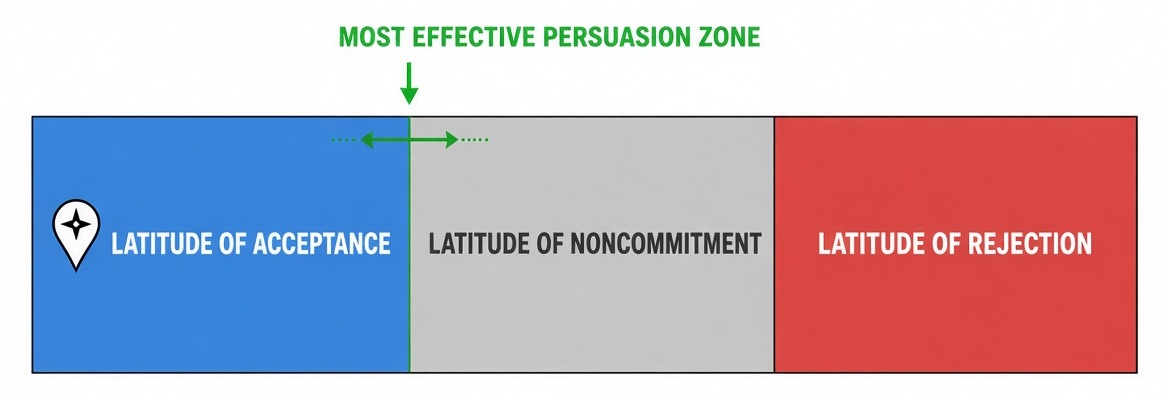
The most persuasive message is the most discrepant message – that is, furthest from their current view – that still lands inside the latitude of acceptance or the latitude of noncommitment.
In other words, the far edge of the acceptance zone and the near edge of the noncommitment zone is the classic “sweet spot.” This is because greater discrepancy creates a larger gap the person must close by shifting their own attitude farther (while still accepting the message).
Slightly discrepant messages have little effects. People assimilate them with almost no thought. They pull the message towards them, hearing it as closer to their own view than it really is.
If a message is too far outside of these bounds and lands inside rejection, the reverse happens: they push it away and hear it as more extreme than it is.
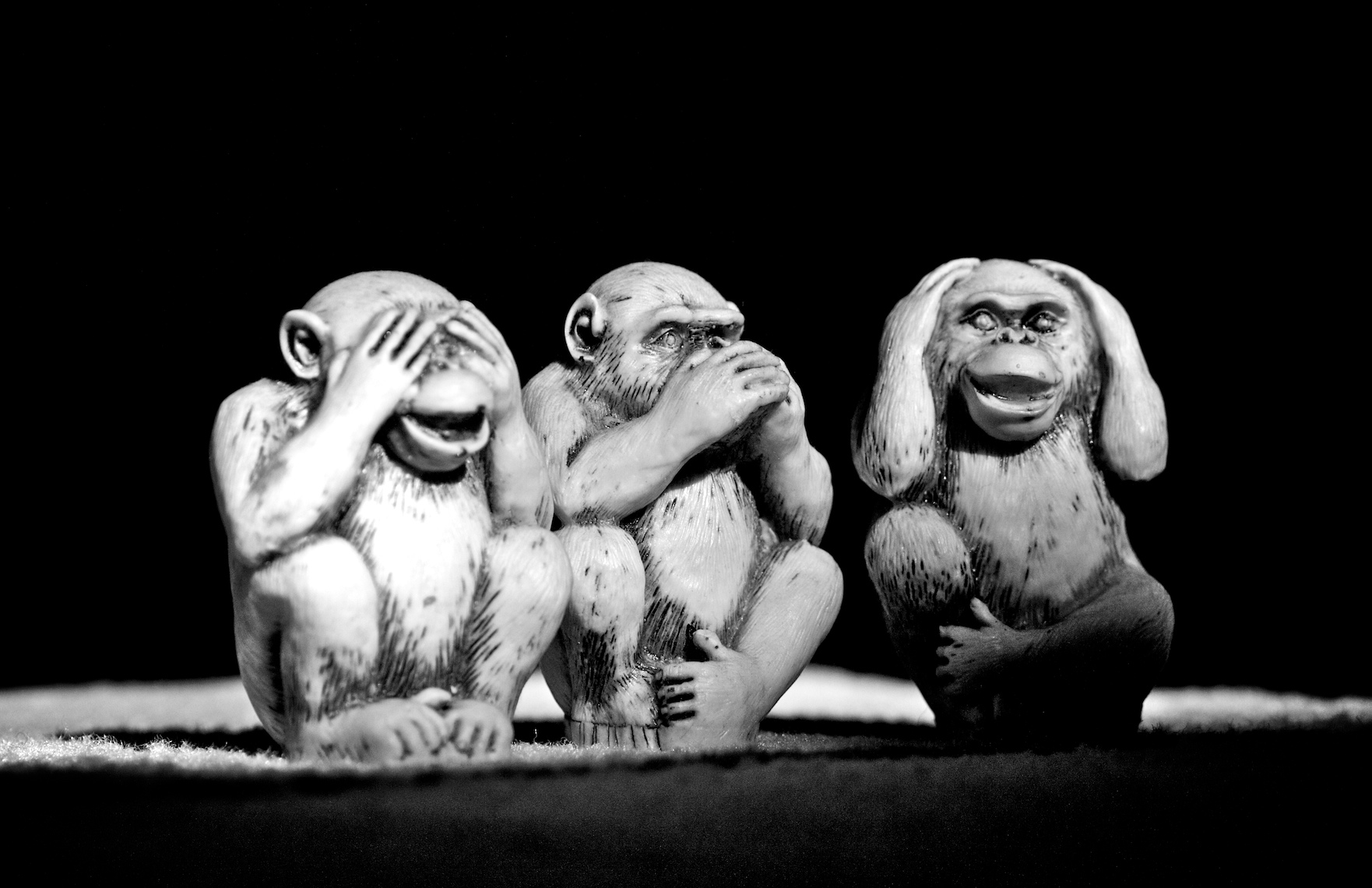
This “rejection zone” is close to what George Orwell described in his masterpiece 1984:
"Crimestop is the faculty of stopping short, as though by instinct, at the threshold of any dangerous thought. It includes the power of not grasping analogies, of failing to perceive logical errors, of misunderstanding the simplest arguments if they are inimical to [the totalitarian ruling party], and of being bored or repelled by any train of thought which is capable of leading in a heretical direction. In short....protective stupidity.”
Attacking someone's belief head-on often makes them defend it harder. If that’s what you want them to do, have at it, but if you’re interested in persuading anyone, emotion, identity and framing beat facts. All of this starts with…
Hoozright maxim #1 of debates: the most persuasive thing you can do is sum up the other side from their perspective using their language, and then lower the cost of them changing their minds
“Crossing tribal signaling boundaries is by far the most important persuasive technique I know, besides which none of the others even deserve to be called persuasive techniques at all.” – Scott Alexander
As a species of social mammal, humans are tribal by nature and yearn for a sense of belonging. We come saddled with a powerful bias called the "myside bias", a form of motivated reasoning that biases us to reason in ways that favour our own groups, such as our favoured political, cultural, religious, or ethnic tribes. This bleeds into the fabric of social reality, including what we find persuasive.
As the “godfather of influence”, the psychologist Robert Cialdini, put it: “People say yes to someone they consider one of them”.
Cialdini caught himself doing it. He grew up in Wisconsin as a Green Bay Packers fan. When he later discovered that Justin Timberlake and Lil Wayne were Packers fans too, he noticed himself immediately thinking more highly of their music.
3. Are you one of us, or one of them?
People view ideas and arguments from "outsiders" through heavy scepticism goggles. Even an idea that would otherwise fall under the “latitude of acceptance” gets shunted into rejection if the messenger is seen as an enemy. “The sky is blue” is common sense from an in-group member and simplistic idiocy from an out-group member; sometimes the sky is grey, black, red, and orange at sunset, not just "blue". One group will soon accuse the other of being a Nazi.
Recall Crimestop from 1984, the cognitive acrobatics of selective and protective stupidity. In a paper that starts with a quote from 1984—“The Party told you to reject the evidence of your eyes and ears. It was their final, most essential command”—a professor of psychology and neural science and NYU summed up the research: “In short, people with high numeracy skills were unable to reason analytically when the correct answer collided with their political beliefs.”
3.1 Language signals
This is why sending in-group signals is the beating heart of persuasion when it comes to ideas. That short-circuits the pattern-matching (“here comes another one of Them”) that would otherwise cause them to tune you out before evaluating anything you say. A couple of examples:
Before you try to change someone's mind, you can dissolve a huge amount of resistance by establishing a shared identity that puts you both on the same side. It can be as simple as “we both want the same thing” about an outcome, such as the best way to best way to keep kids safe online, the best way to stop people ending up back in prison, or any of countless things people debate about. To dissolve even more resistance, the next most powerful psychological technique is…
4. Accurately describing their perspective
When two people strongly disagree, it is rare that either of them can summarise the other's position to the other's satisfaction.
In his book Never Split the Difference, Chris Voss, a former FBI hostage negotiator, distils a persuasion principle down its essence: rephrase their point of view such that they can say “exactly” or “that’s right”. (Note that this is different than them saying “you're right”; that means they want you to stop talking).
This changes the person's state of mind, opening the persuasion window. One way to do this – as close to a real "hack" as you'll get – is to use verbal mirroring. As Chris Voss writes:
“It’s almost laughably simple: for the FBI, a “mirror” is when you repeat the last three words (or the critical one to three words) of what someone has just said. Of the entirety of the FBI’s hostage negotiation skill set, mirroring is the closest one gets to a Jedi mind trick. Simple, and yet uncannily effective."
It might feel weird, forced, and artificial. But if it works, it works. People crave the sense of being understood, and even simple tricks like mirroring work as a result.
But to take this up a gear and do this properly…
4.1. Know their ideas better than they do
“He who knows only his own side of the case, knows little of that.” – John Stuart Mill.
If you don’t know the opposite perspective, it means you don’t understand your own one either; you’re regurgitating talking points rather than holding a perspective you’ve thought through from all angles and stress-tested against opposing points of view.
Following the approach Charlie Munger takes would put you ahead of 99% of people in terms of the quality of your understanding of different viewpoints: “I never allow myself to have an opinion on anything that I don’t know the other side’s argument better than they do.”
You can start to do this through…
4.2. Listening to what people actually are saying
I challenge you, dear reader, to come up with a single sentence that cannot be distorted in absurd ways by another human being. It can’t be done. You can make your sentence extremely short, but people will fill it in with false inferences (“so what you’re saying is…” followed by nonsense). You can make it extremely long, but people will just have more surface area to attack and misunderstand.
Which brings me to…
Hoozright maxim #2 of debates: Whatever idea you want to get across, someone else will know much better than you what you really meant.
Now throw in heavily charged topics – Gaza, Palestine, Israel, Ukraine, climate change, gender affirming care, what to do with murderers – and it’s little surprise online debates are so riddled with divisiveness and unproductive conflict. Few people are arguing with civility or honesty. Anyone trying to figure out what's going on from different perspectives has to wade through debates riddled with misrepresentations of the other side.
One of the most common debate tricks is the “straw man”, where someone deliberately misrepresents the other person’s argument – and never in a positive direction. They ignore the other person’s real idea and they prop up an easily defeatable effigy of the idea – one that’s flimsy and easy to attack.
These cheap tricks are effective, unfortunately. They often persuade observers of a debate but they immediately close off the opponent’s mind to any persuasion and the debate devolves into shit flinging.

Doing the opposite of the straw man is extremely persuasive. It's called...
4.3. The steel man
Next time you are arguing with someone, ask them to “steel man” your point of view – and you do the same for them. That is, repeat their points back to them in the most robust, fair, even flattering way possible.
Until that happens, don’t move forward in the argument. You might be surprised how bad both of you are at it.
How do you figure out the ins and outs of their worldview?
4.4. The rare skill of listening
Just trying to imagine other people’s perspectives doesn’t really work. You need to listen to them.
So start by listening to other people’s perspective: have them say what they really think. Stay curious. Why do they believe this?
Then try to summarise it accurately.
You can check with them whether your interpretation is correct: “Have I got your view right? Is there anything I’m missing?”
The ability to describe what someone else is thinking and feeling is one of the most valuable psychological tools you could have. Unless you’ve consciously tried to do it – with your spouse, your friends, your colleagues – you probably underestimate how effective it is.
Good listeners are rare, and they are extremely persuasive. If you can listen to someone’s idea and re-describe it to them such that they say “that’s right”, your persuasiveness and trustworthiness in their eyes shoots through the roof.
You don’t have to agree with a single thing the other side believes to sum up their ideas accurately. You can think they’re completely delusional. Doesn’t matter.
Once you've done that, you can start to nudge them towards new perspectives. One of the strongest levers to do this is...
5. The Socratic method: The power of specifics
Pointed questions can bring startling clarity and insight. Questions pry open nooks and crannies of the mental world that could otherwise lie unexplored, because they force active thought.
The “Socratic method” is a powerful form of this. It involves asking probing questions that guide the other person to come to their own updated conclusions, including admitting or thinking through the blindspots in their arguments.
Without sounding like a patronising twat, to start you can ask simple questions that make them think about their position. For example, ask them to briefly outline their reasoning, that is, why they hold the view they hold. Or how does their idea work? Can they give a specific example? Or ask them to cite specific examples of disagreement. What specific points of yours do they disagree with?
We often hold views for reasons that we never fully explored or stress tested. The act of simply describing these views opens a crack of doubt that makes us more open to considering other perspectives.
The “illusion of explanatory depth” is the name for this, where you don’t know what you’re talking about but you don’t realise it until you’re asked to explain your reasoning.

If you're dealing with someone who hasn't given much real thought to their ideas, they'll go silent or stumble, their minds thrown off by the sudden momentary need to be accountable to specific details they can’t invent.
The nuclear option of questions is, “what would change your mind?” If the answer is that nothing could convince them that their cherished beliefs are false, these people are no longer open to reason. Their beliefs are only selectively tied to reality.
That's why Socratic questioning is so devastating to liars and bullshit artists and so quickly rouses them to anger. Fight or flight kicks in. The slightest scrutiny makes them fold. Some spew insults, some shut down and storm off, and some resort to comebacks that essentially boil down to “that’s the way it is because that’s the way it is”.
That's good information to have. In that case, you know you’re not dealing with a serious person and shouldn’t spend any more time in the debate. But for the honest ones, the questions will likely trigger some cognitive dissonance. And this brings up the importance of...
6. Giving people an out, a “golden bridge” to save face
As the saying attributed to Max Planck goes, science progresses one funeral at a time.
People cling, and cling hard, to ideas that they have built a life upon. Very few of us are exempt from this psychological pull.
They will do almost anything to save face when proven wrong, especially in a debate. They rarely admit to being wrong in real time. When they do change their minds, they do it in private, and it might take weeks or months. This helps create the illusion that people rarely change their minds, because you don’t see it during the debates.
The more they have publicly declared a belief, the harder it is for their egos to relinquish it publicly. The more they dislike the person who has proven them wrong, the more intensely they will refuse to concede defeat. And the more ridiculous the belief they held, the bigger the hit to the ego to admit it was wrong, so people predictably develop the “double down disease”.
Admitting when we're wrong is hugely important. It’s a major step to personal growth and getting at the truth, rather than being mired in egotistical delusion. One way to ease this along is to give people a face-saving route to changing their mind, a “golden bridge of retreat”, a term attributed to Sun Tzu in The Art of War.
AIs do it all the time, in telling you “your instinct was right”. Little concessions like, “I caused confusion by explaining this badly the first time” work wonders.
Easier said than done, but a great path forward is fostering more online communities where our social identity and status hinges on trying to be right rather than appearing right, on making accurate predictions, and generally being able to upgrade our views as new evidence comes in without a confederacy of dunces accusing us of flipflopping.
7. Isn't arguing just a waste of time?
The best and worst thing about the internet is that everyone has a voice, but an unavoidable consequence is that the people with the least-thought-out opinions are the most eager to share them. They post often with little thought or effort, gaining a speed and volume advantage over more conscientious people who post occasionally and thoughtfully. This floods the comments – the “discourse space” – with a disproportionate amount of idiocy and creates the illusion that everyone online is a moron. And so you get the line, “you’ll never change anyone’s mind online, don’t bother”.
For a sizable minority of people, this is true. Nothing you could say to them will budge their perspective. They couldn’t care less about ideas for their own sake, or taking other people’s perspectives, or upgrading their minds to see the world more accurately.
This includes bright people who score low on innate personality traits such as openness to experience and need for cognition, the traits that predict whether someone will entertain new ideas, appreciate debate, among other things.
However, it's worth zooming back and looking at the numbers. In most online communities, the overwhelming majority never post. A common rule of thumb is 90% lurkers, 9% occasional contributors, 1% heavy contributors.
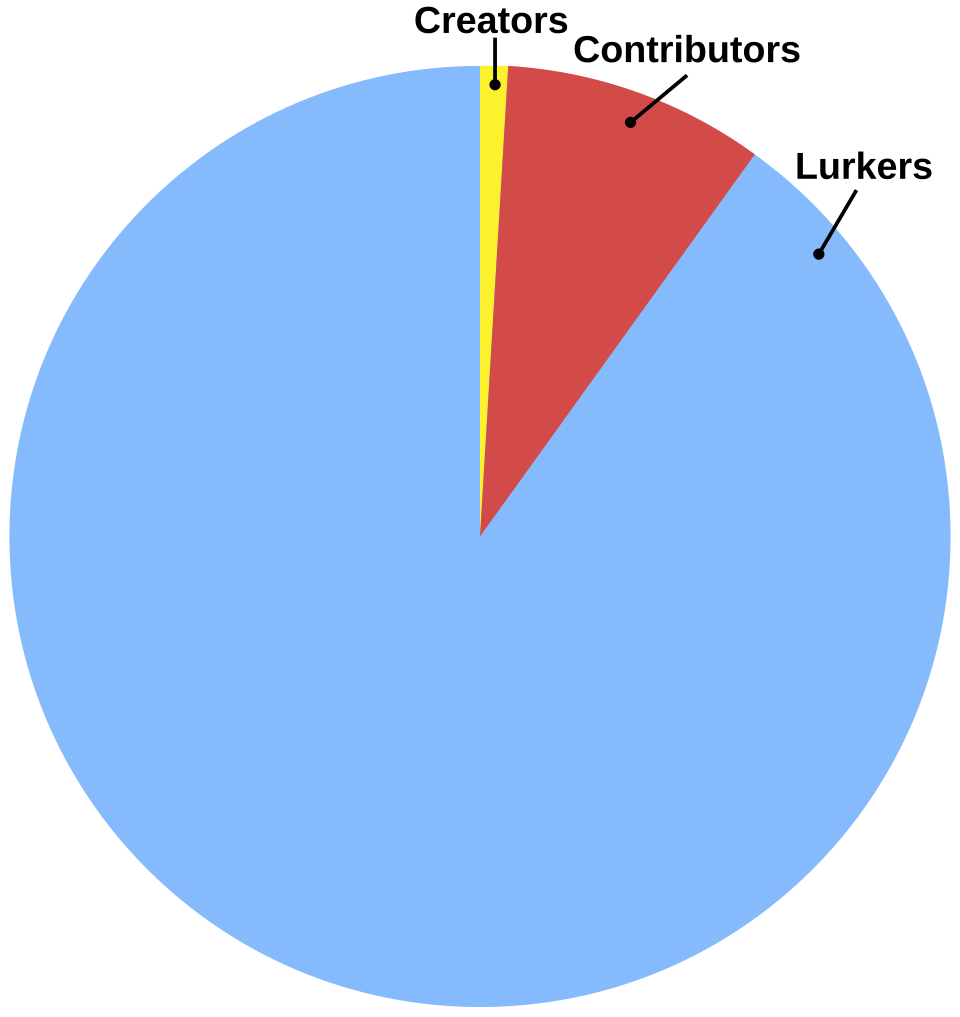
Among the highly visible 1% are the most brilliant, creative, interesting people. But also among the 1% are people who differ in their psychological profile from the 99% in important ways that everyone should understand if they want to stay sane.
The online world is teeming with ideologues, psychopaths, chauvinists (male and female), trolls, and the defiantly ignorant who just want to spout nonsense unchallenged.
Most of the audience are not commenting. We ignore the millions of people not liking that deranged post, not posting deranged opinions, not behaving like an attention-seeking narcissist.
Reams of intelligent silent viewers and low-volume posters don’t get involved in online debates in part due to Brandolini’s law: “The amount of energy needed to refute bullshit is an order of magnitude bigger than that needed to produce it.”
Many of the silent observers are undecided on whatever topic is under debate, and they’re open to persuasion. So even if you can't persuade your debate opponents, the silent audience can be persuaded.
But not everyone should be given the oxygen of attention, and that mostly involves...
7.1. Trolls and haters
“Never wrestle with a pig. You get dirty and the pig likes it.” (usually credited to George Bernard Shaw, who never said it.)
One of the ancient, unspoken rules of the internet is “don’t feed the trolls”. Shit stirring is their stock in trade. Trolls feed off your attention. Their goal is emotional vampirism.
Same with “haters” (distinct from people who give us valid criticism we don’t like). The internet is full of people drowning in their own misery and desperate to pull others down too. Sometimes they dress up their shitty attitude in a moralistic gloss. A lot of them are mentally unwell and use the internet as a crutch to deal with their emotional issues.
Don’t waste your time trying to persuade these hobgoblins.
8. Turning the magnifying glass around
The bias blind spot is independent of intelligence, cognitive ability, decision-making ability and self-esteem. All of this applies to you. And me. All of us. If you’re interested in being persuasive and developing a more evidence-based worldview, a great first step is being aware of the “primary law of human nature” and the cognitive funhouse mirrors it stands up in the mind: confirmation bias, myside bias, and the conviction that people who disagree with us are idiots or evil (though some are).
Some steps to improve them that we talked about:
The internet has enough angry ranting semi-coherent people on it. What it needs is more clarity of thought and quality of debate around the issues of the day and the evergreen issues of the human condition that will never have neat consensus.
Looked at in its proper perspectives, the stakes are high. The neuroscientist Sam Harris pointed out that we all live with perpetual choice between two stark binaries: Conversation and violence. Persuasion or coercion.
“The importance of conversation can’t possibly be exaggerated because it is the bulwark against perpetual violence, it’s the bulwark against murder, it’s the bulwark against war. It’s the only thing keeping those things out of our daily experience”.
We need the skills of quality communication and persuasion now more than ever.
In the absence of debate and feedback from others and reality, groups descend into groupthink and delusion. A cursory glance at the most toxic ideologies shows that they all have one thing in common: squashing curiosity among its adherents and putting up robust cognitive firewalls preventing criticism.
This is one of the main reasons high-quality debates are essential for shedding off nonsense ideas that can’t be justified with reason and evidence, collectively driving humanity towards less bad ideas over time, aka progress. Arguments and debates are a major vehicle to figuring out what is true and making progress in our understanding of the world and of the people we occupy it with.
We learn a huge amount when we engage in productive dialogue with people who see the world differently from us. Both in the real world and online, we could all make a greater effort to build bridges with those who hold opposing views.