
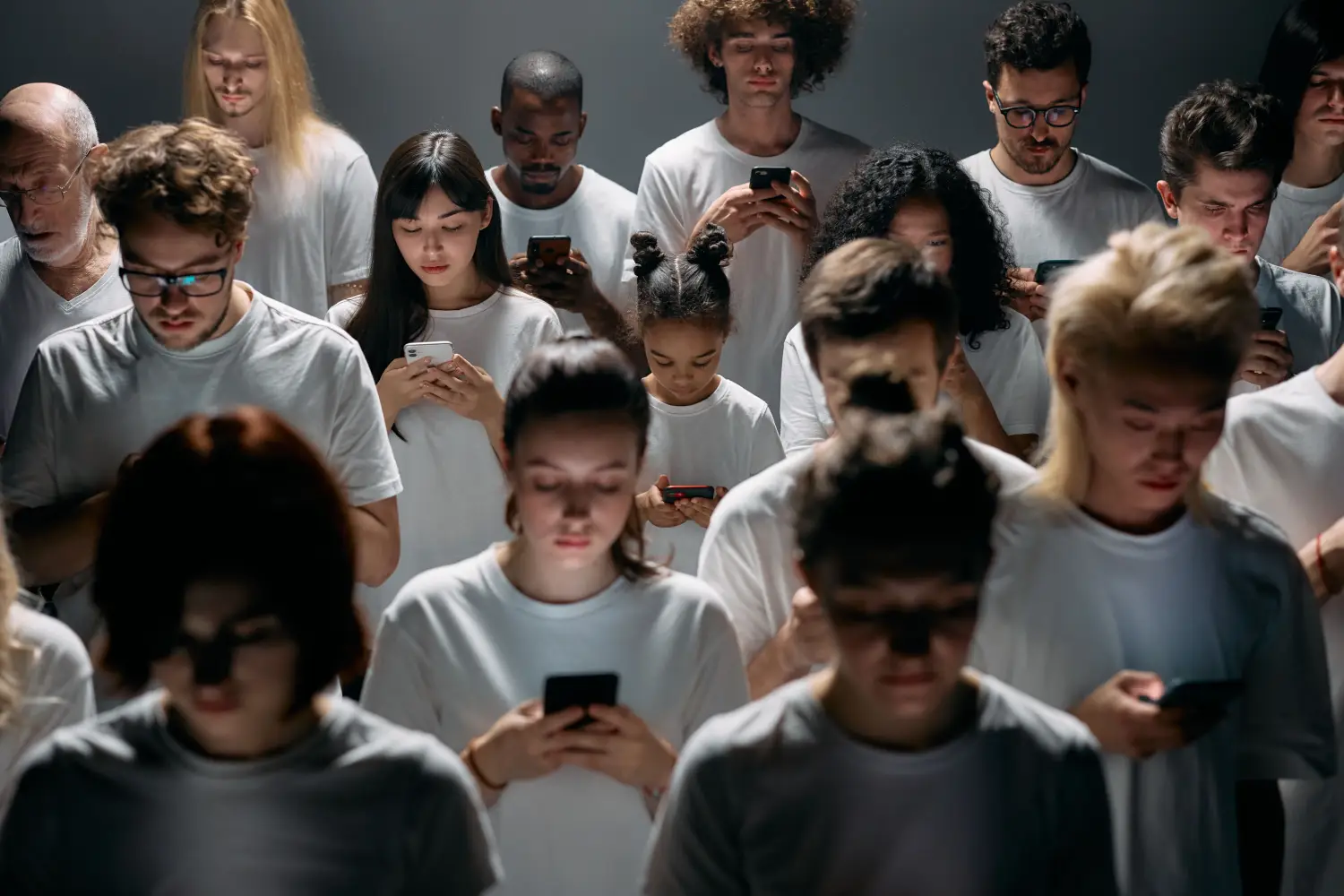
Engineered addiction
Social media is engineered to steal your time, warp your sense of reality, and keep you scrolling. This is how it works -- and why Hoozright is built differently.
Imagine you’re watching a movie at the cinema. The end credits are rolling after a three-hour movie that fully captivated you.
You’re leaving the cinema, walking out into the daylight, your eyes adjusting. Daylight, clouds, blue sky, people walking to and fro. Looking around, the movie of your own life is now three hours closer to the end.
Do you regret spending three hours of your precious life in front of pixels, absorbing a simulated reality, while the real one is all around you, temporarily forgotten? Of course not, you enjoyed yourself. Time you enjoy “wasting” is not wasted time, and that includes screen time.
The internet – a word so broad that it’s like saying “the world” – can be a fantastic place, full of creativity, fascinating dialogue, brilliant ideas, education, hilarious comedy, and quality entertainment. Like a great movie, it all depends on what you choose.
That goes especially for how you use social media. Is social media “the new smoking”, as it’s often called? In the early 1950s, serious evidence was starting to show that smoking causes cancer. But the medical profession rampantly denied the link. People in public policy (most of them smokers) were squawking the usual refrain that correlation doesn’t equal causation. Worse, because the Nazis had originally established the link between smoking and cancer, public health officials were slower than they should have been in acknowledging the link, and tobacco companies were calling anti-tobacco campaigners “believers in Nazi science”. (Some things never change – different scenario, same bullshit).
I think we’re going to see a similar dynamic play out with social media, but it’s not as straightforward.
Time incinerators
Well-paid armies of behavioural scientists are working hard to make sure social media (including Tiktok, YouTube, X, and all the usual suspects) are as addictive, time-consuming, and time-warping as possible – and they're very good at it.
People worldwide spend about 6½ hours on average every day looking at screens for leisure. Browsing the internet, watching TV, watching streaming series, gaming and so on. Let’s imagine, just for the sake of argument, that those numbers are wildly exaggerated. Say it’s “only” 3 hours a day. Play the tape forward and that adds up to 15 years of your waking life spent looking at a screen. Some of that will be very well spent (if you’re still reading this rather than skimming around manically, congratulations, your mind isn’t fried) but some of it will be, by the person’s own account, a complete waste of time.
Some of you might be thinking, well that’s other people. I encourage you to download a time tracker on your laptop and phone to monitor how much time you spend on them each day. If the number is higher than you think (and it is), it’s not really your fault because most of the popular apps on your phone are cleverly designed to distort your perception of time.
All of the techniques these behavioural scientists use exploit universal vulnerabilities in our psychology. Knowing them – and I’m about to outline the most important ones – gives you a shield and more open eyes to navigate a landscape that’s increasingly engineered to steal your time.
First, AIs are hard at work learning your interests and feeding you content that’s tailored to your emotions and attention patterns. Your feed feels hyper-relevant, so it’s harder to disengage. So far, no big deal. Who wants to look at irrelevant content?
Enter: “Infinite scroll”, the lack of a natural stopping boundary. There’s no last page like in a book, no rolling credits like in that 3-hour movie. Movies and books have a clear beginning and end. Yes, you can always start another or let Netflix’s sneaky “watch next” autoplay take over, but there’s a built-in forced handbrake. The length of a film or episode is a natural stopping point. Also, it helps that most of us watch movies on larger screens in our homes – screens with a fixed position in a room, not in our pockets.
Ok fair enough you might be thinking, content is infinite, but if you’re enjoying yourself, what does it matter? And surely you can be an adult and apply some discipline? You don’t have to sit there slack-jawed, glazed-eyed, drooling on yourself while shadowy figures orchestrate campaigns of digital bread and circuses to keep you sedated and distracted with inconsequential nonsense, whittling away your precious time?
Of course. But the most sinister effect of addiction-based digital manipulation is that it’s engineered to warp two things: your perspective of time, and your perspective of reality.
Addiction by design
Social media digitally exploits the same principles casinos use to keep people hooked. Engineers of slot machines use a potent technique for keeping someone compulsively locked into a behaviour. The jargony name for it is “variable ratio reinforcement schedule”. Put simply, it means the wins are intermittent. They come at random. You never know if it’s the next pull or the hundredth. This has been shown to put people into a trance-like state where they compulsively keep doing the behaviour and keep coming back to it.
Those devious behavioural scientists of course have engineered the same techniques into social media, because that’s what they’re paid to do; that’s the dashboard with numbers and targets they’re working from. When you’re scrolling, you don’t know what the next post will be about. It could be funny, dull, inspiring, insipid, shocking, tame, wholesome, bizarre. This is by design, and it’s called “anticipation under uncertainty” (another term of jargon in the psychology of addiction). Short-form content in particular is designed to keep you hooked while blinding you to how much of your life is getting sucked into the digital void.
Do we use behavioural science at Hoozright? Of course. So does your alarm clock. The question is what the psychology gets pointed at. We're against attention extraction for ad views or anything else. We're trying to change what the internet rewards.
Time perception
After the three hour movie, you’ll feel fine, even great. After three hours of scrolling Tiktok, notice how you feel. You’ll feel lousy. Maybe a bit arsey and short-tempered. You’ll carry around a low-grade anxiety, a weird sense of being off. This is because our Stone Age brains – having evolved for a much smaller scale of tribal life – aren’t well-designed for such a wild succession of emotional spikes and twists and turns. It creates an emotional scrambling, leaving a weird quasi-hangover.
Just think of how unnatural the visual display of social media is – a kaleidoscope of different scenes with wildly varying emotional registers, like a drug trip – compared to a movie (even ones with the most outlandish plots) that have relatively realistic and coherent cause-and-effect physics and dynamics.
To prove this to yourself, just notice how you feel after spending an hour listening to a long-form podcast, say, versus an hour scrolling TikTok. No matter how compelling and absorbing the podcast was, it won’t feel as short as the time scrolling TikTok. The constant novelty of short-form media and the rapid stream of new stimuli overwhelms your attentional system. It keeps your brain in a state of constant engagement without giving it the chance to consolidate the passing of time. The result is a strange sensation of unnaturally rapid time loss and stolen attention. And all we have in this life is time and attention.
Reality distortion
Of the 8 billion people on the planet, more than 5 billion are online. Around 90% of those people never comment at all. 9% comment occasionally. And just 1% create the vast majority of what you see.
To put the scale in perspective, let’s look at the population of Switzerland, about 9 million people. Imagine 1% of Switzerland – about 90,000 people – gathered in Bern yammering into overpowered megaphones, desperate for attention. As a rough comparison, 90,000 is roughly the capacity of Wembley Stadium.

Anyone observing Bern would think the whole city is deranged. In reality, the other 99% – the 8,910,000 other people – are going about their day getting on with their lives. Online algorithms put a megaphone in the hands of the loud, attention-seeking 1%.
Having a thin slice of a cake lets you know what the overall cake is like. Seeing thin slices of a person’s behaviour gives you major clues about what the overall person is like. But this is not true of the thin slices of humanity you see online. You’re seeing a strange 1%, not a representative slice of human behaviour. Your friends, the person you’re married to, the people you interact with every day – they’re almost certainly nothing like the people you see plastered over the news or your YouTube feed.
That 1% is a funhouse mirror made up of, let’s say, psychologically unusual people. Now, I like unusual people. I love freethinkers, eccentric people, people with a personality and people with the courage of their convictions. Give me an interesting eccentric any day over a bland bore with prepackaged opinions. That said, not all types of “unusual” are made equal.
The internet is both a catchment area and a microphone for the most radicalised, emotionally incontinent, infantile, psychologically unstable, uninformed, perpetually aggrieved, chauvinistic (of both sexes), psychopathic, unkind, and attention-seeking people on the planet.
Nuance on the internet is like an octopus hunting on land. Possible but extremely rare. Dip into x.com and search for “American politics” or “culture wars” and try to wade through the digital sewer for a few minutes without despairing for humanity. You’re seeing the most extreme and nutty perspectives, and the quality of the content these people produce is abysmal: uncharitable, surface level interaction with endless misrepresentations and casual insults. If you have any preference for nuance and dislike of mindless tribalism, you’ll find even five minutes in this wasteland unbearable.
On the internet, the shit floats to the top. You won’t find a lot of wisdom, emotional maturity, or self-possession unless you really burrow deep.
On top of this, an enormous number of posts aren't even from humans. Nobody knows exactly what percentage, but it may be a substantial minority. They're generated by bots, churned out by bot farms for commercial and geopolitical gain. Some are designed to sell, others to polarise and spread political disinformation, and some are created purely for shits and giggles.
Before you respond to someone with daft opinions on x.com, remember that’s who you could easily be talking to: soulless code. (Obligatory public service announcement: We embrace AI at Hoozright but not for deception and will crack down on fake accounts).
“All empty souls tend toward extreme opinions” wrote the Irish poet W.B. Yeats. He was more right than he knew.
Tricks of the mind
We also come saddled with the (plainly named) “negativity bias”, a predisposition to dwell more on the negative than the positive. Negative news and negativity in general is more memorable, more interesting, and more stimulating. It’s also more damaging long term to a person’s mental health.
Imagine that you posted a video of yourself on YouTube playing the piano. A load of positive comments start coming in. Then you see one “ur shit” comment by twatfluffer_69 and it sticks in memory much deeper than a hundred neutral or kind interactions.
On a larger scale, evidence is starting to pile up to show that the sharp rise in adolescent anxiety, depression, self-harm, and loneliness since the early 2010s is closely tied to the spread of smartphones and social media. The biggest drivers seem to be platforms like Instagram and TikTok that do a few things in tandem: amplify social comparison (comparison is the thief of joy), screw up sleep, open the door to cyberbullying, zoom in on the negative and tragic aspects of life (if it bleeds it leads), and shamelessly use addictive design techniques like infinite scroll and variable ratio reinforcement schedule and others that currently have Meta embroiled in court cases.
The verdict isn’t in yet – the connection might turn out to be overblown, or the causality could be backwards (maybe young people with mental health issues caused by something else gravitate towards social media). However, given everything we know about how these technologies work, I would suggest this needs to be explored and taken seriously and not dismissed (as the statistician Edward Tufte put it, “Correlation is not causation but it sure is a hint.”), just like the effects of smoking finally were in the latter part of the 20th century.
My prediction: by 2035, the scientific consensus on social media and adolescent mental health will look like the consensus on smoking and cancer did by the 1970s – established, and denied only by the industry that profits from it. Age limits, warning labels, or both will be law in a growing list of Western countries. That's what I think will happen. Whether it should is a debate in itself.
It’s worth repeating: not all social media is bad, just as not all chocolate is bad. Social media can be a source of fantastic journalism, hilarious skits, harmless entertainment, and easy connection with friends across countries and continents – as long as you’re aware of the traps and use it thoughtfully. Some people have no problem whatsoever with social media, and others are fully addicted and need to avoid it entirely. Others – the various internet celebrities – actively promote it because they make money from it.
Some people revel in pointing out the irony of sharing an article criticising social media on social media. But where better to share this than with the people who might need it most? Those who are off social media already got the message.
Fighting back
A surprising number of people don’t know you can do this: If you don’t want crap showing up on your feed, but you don’t want to abandon social media, the most important step is to continually click “not interested” every time you see something you don’t like. Could be some crackpot posting something unhinged or inflammatory, or some banjo-eyed keyboard revolutionary celebrating political assassinations. Keep clicking “not interested” until eventually the algorithm figures out what you don’t want to see. Eventually, your feed can be great.
Isn’t Hoozright just another social media platform? No. Remember the 99% in Bern who never touch a megaphone, the ones going about their lives? On Hoozright they get counted. A vote takes seconds. It puts your prediction on record, and together those predictions reveal what the crowd expects to happen.
There's no infinite scroll here. Debates close. A vote is a discrete, completed act: you make your call, it goes on the record, and the debate ends with a verdict. Credits roll. You walk out into the daylight.
Social media is engineered to incinerate the most important thing that you have: the finite hours of your life. Maybe over 30 years of it. Not just that, but it’s showing you mostly garbage that you passively absorb, an IV of digital junk food.
Everything described above rewards one behaviour: staying. Watching, absorbing. Passive intake, hour after hour.
Hoozright rewards making a call, putting it on record, and being accountable for your judgement. You can't scroll your way to a reputation score. You have to commit. Hoozright is a reputation system for judgement, built around prediction rather than opinion. That means you're rewarded for reading the crowd accurately, not for shouting the loudest like the small minority dominating online conversation.
Hoozright is about what we believe is the most important thing the internet can do: foster dialogue, sharpen your thinking about the issues of the day, take part in important discussions, and when you’re done, to log out and enjoy your life.
For the last twenty years, the internet has become increasingly effective at capturing attention. We think the next twenty should be about improving how people debate and make judgements.
If you like the sound of that, stick around – there are interesting developments in store and we would love for you to be part of it.